


Our state-of-the-art facilities, cutting-edge technologies, and experienced team of scientists are dedicated to providing comprehensive and accurate phenotyping services to support your agricultural research and breeding programs.
Phenotyping plays a pivotal role in understanding the complex interactions between genetics and the environment, enabling us to unlock the full potential of crop species. At Phenotyping Services, we specialize in capturing and analyzing detailed phenotyping data, allowing you to gain valuable insights into traits related to yield, stress tolerance, disease resistance, nutritional quality, and more.
With our diverse range of phenotyping techniques, including field-based observations, remote sensing technologies, high-throughput phenotyping platforms, and controlled environment facilities, we offer a comprehensive suite of services tailored to your specific research objectives.
Our team works closely with you to design customized phenotyping protocols and deliver accurate and reliable data that drive informed decision-making undergirded by a strong commitment to quality assurance.
Additionally, we provide access to our extensive phenotyping databases, analysis tools, and expert guidance to support your research endeavors.
We understand the unique challenges faced by agricultural systems worldwide, and our expertise extends to various crops, including cereals, legumes, fruits, vegetables, and ornamentals. By leveraging our cutting-edge technologies and knowledge, we empower breeders, researchers, and agricultural organizations to enhance crop performance, increase resilience, and develop improved varieties that meet the demands of a changing world.
Collaboration is at the heart of what we do. We foster partnerships with the scientific community, breeders, and industry stakeholders to collectively address the complex challenges faced by agriculture. Through knowledge exchange, data sharing, and collaborative research projects, we aim to push the boundaries of plant phenotyping and drive agricultural innovation.
ICRISAT’s High Throughput Phenotyping platforms integrate advanced sensing technologies, automated data acquisition systems, and analytics to accelerate the characterization of plant performance across diverse environments, management conditions, and end-use requirements. These platforms support precision crop improvement by enabling rapid, large-scale evaluation of physiological, agronomic, and quality-related traits.
LeasyScan is a fully automated high-throughput phenotyping platform for rapid, non-destructive assessment of canopy development, transpiration, and stress adaptation traits using real- time data acquisition. The facility has around 4608 microplots and supports screening of large germplasm collections for adaptation to stresses such as drought, heat and salinity, and also evaluates agrochemical effects on crop performance.
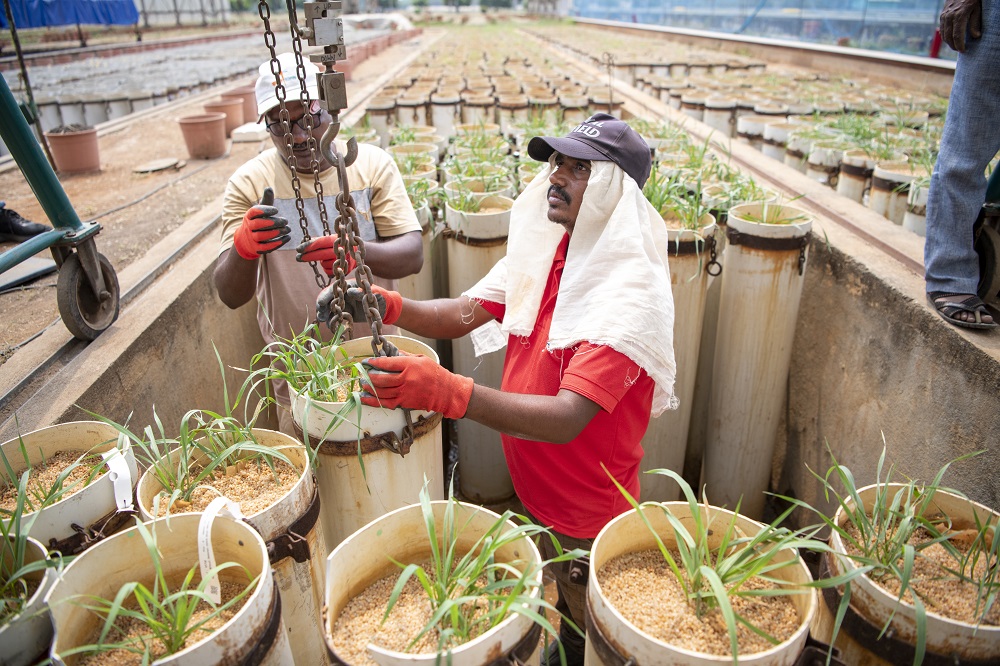
The lysimeter facility enables precise quantification of crop water use, transpiration, root-related traits, biomass and yield under controlled water regimes. It comprises approximately 4,500 cylinders of different sizes with different soil types suited to multiple crop types and supports detailed studies on drought adaptation, water extraction dynamics, and water-use efficiency.
ICRISAT, in collaboration with IT partners, is advancing AI-enabled UAV-based phenotyping for crop improvement in India. The platform uses RGB, multispectral, and hyperspectral sensors to capture high-resolution field data for assessing agronomic, quality, and stress-related traits. It develops standardized imaging protocols and automated analysis pipelines to generate reliable crop indices for breeding decisions
The Hydroponic Root Phenotyping Facility enables precise and high-throughput evaluation of root traits under controlled conditions using standardized nutrient solution systems for legume and cereal crops. The platform supports measurement of root architecture traits, including root length, surface area, volume, crown roots, and lateral roots, with the advantage of non-destructive root phenotyping. The facility also enables controlled nutrient treatments and supports studies on water transport pathways in crops
The NIRS Facility uses the 750–2500 nm spectral region for rapid, non-destructive assessment of crop quality traits and organic composition through advanced spectroscopy and predictive analytics. The facility supports high-throughput analysis of moisture and quality traits such as protein, starch, oil, fatty acids, carotenoids, amino acids, and digestibility.
CT enables rapid, non-invasive, and precise post-harvest phenotyping of grain physical properties. It leverages X-ray imaging combined with advanced image analysis algorithms for trait extraction and prediction. At ICRISAT, CT technology is being used for groundnut (shelling percentage, kernel size, grading) and rice (chaffiness, chalkiness, head rice recovery) and is being expanded to additional crops for broader applications in grain quality assessment.
The X-ray Fluorescence (XRF) Facility enables rapid, non- destructive analysis of elemental composition in crops. It provides precise quantification of inorganic elements such as Fe, Zn and Ca with minimal sample preparation, offering a fast, cost-effective, and high-throughput alternative to conventional mineral analysis methods.
H2 Classic GrainGage Facility
The H2 Classic GrainGage is a field-based, high-throughput phenotyping device that enables rapid, accurate, and non-destructive measurement of key grain traits such as grain weight, moisture content, and test weight. It processes samples within 30–45 seconds, supporting efficient data collection for harvest and post-harvest decision-making. The system uses crop-specific moisture calibration equations to improve measurement accuracy and support agronomic and harvest management decisions.
Should you have any questions or require further assistance, our dedicated support team is ready to help. Please email: icrisat-research@icrisat.org
For more information please conatct: Dr Sunita Choudhary